Notes and Commentary
by Ken Puls
on John Bunyan's The Pilgrim's Progress
Part Two
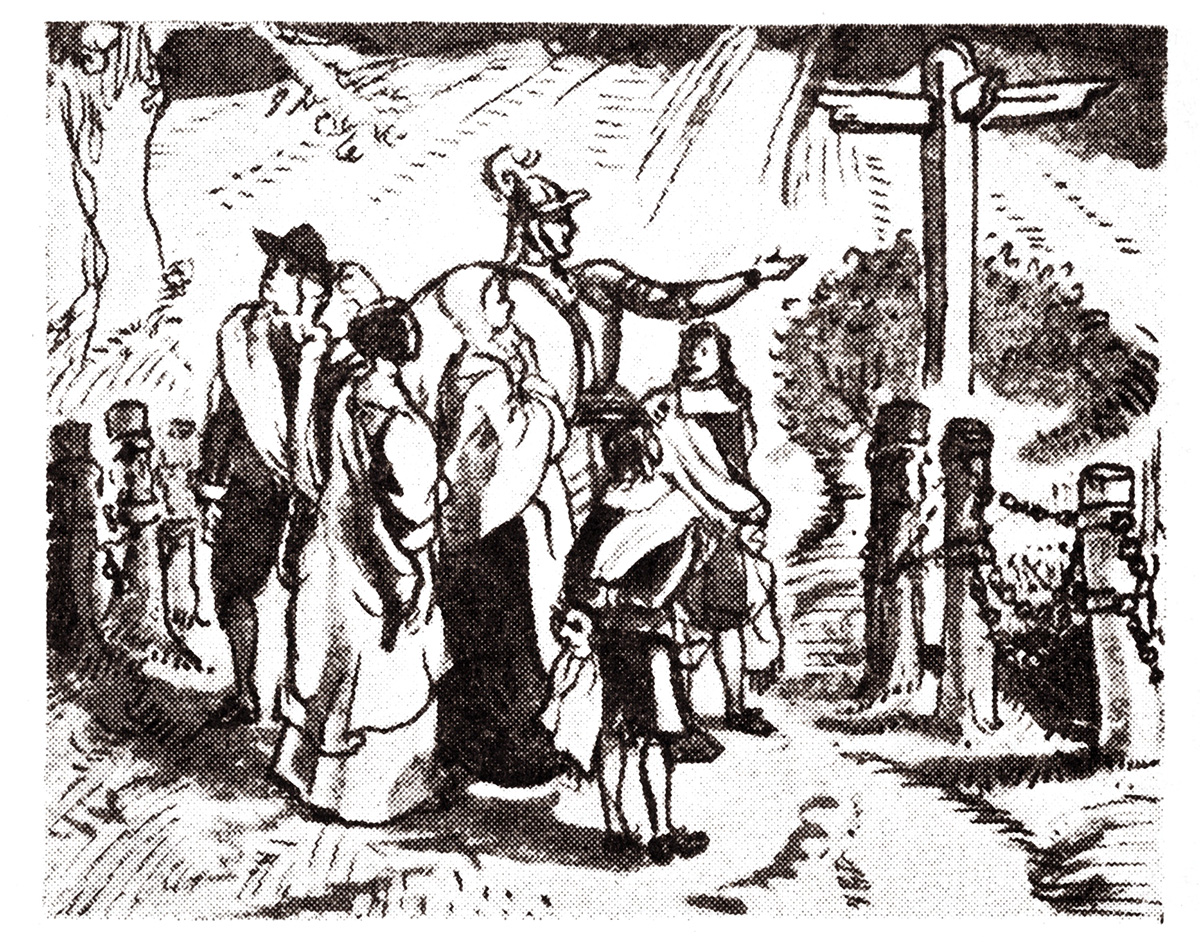
44. The By-Ways of Danger and Destruction
Notes and Commentary
by Ken Puls
on John Bunyan's The Pilgrim's Progress
Part Two
44. The By-Ways of Danger and Destruction
Next, he showed them the two by-ways that were at the foot of the hill, where Formality and Hypocrisy lost themselves. And, said he, these are dangerous paths. Two were here cast away when Christian came by. And although, as you see, these ways are since stopped up with chains, posts, and a ditch, yet there are that will choose to adventure here, rather than take the pains to go up this hill.
Christiana: “The way of transgressors is hard.” It is a wonder that they can get into those ways without danger of breaking their necks.
Great-Heart: They will venture. Yea, if at any time any of the King’s servants do happen to see them, and do call unto them, and tell them that they are in the wrong ways, and do bid them beware the danger, then they will railingly return them answer, and say, “As for the word that thou hast spoken unto us in the name of the Lord, we will not hearken unto thee; but we will certainly do whatsoever thing goeth forth out of our own mouth,” etc. Nay, if you look a little further, you shall see that these ways are made cautionary enough, not only by these posts, and ditch, and chain; but also by being hedged up, yet they will choose to go there.
Christiana: They are idle; they love not to take pains; uphill way is unpleasant to them. So it is fulfilled unto them as it is written, “The way of the slothful man is as a hedge of thorns.” Yea, they will rather choose to walk upon a snare, than to go up this hill, and the rest of this way to the city.
Notes and Commentary
Now that the Pilgrims are refreshed by the Spring, they are better prepared to discern and avoid danger. Difficult trials are ahead, looming in their path, and it will be tempting to shrink back or seek a way around them.
Soon they will ascend Hill Difficulty. The hill represents the struggles we face in this life, especially as we follow Christ and walk in obedience to His Word. God has ordained that we face trials. They are unavoidable as we battle against sin—sin in our own hearts as well as sin in this world. They are unavoidable as we journey through a world opposed to God and in rebellion to His Word. Ascending the hill will be difficult, but at its base are more perilous pathways.
Two By-Ways veer from the true Way “at the foot of the hill.” We learn in Part 1 of The Pilgrim’s Progress: “Now the name of one of these ways was Danger, and the name of the other Destruction.”
The pathway of Destruction leads “into a wide field, full of dark mountains.” The “dark mountains represent mistaken beliefs and misguided opinions about God and how He governs His creation. They include thoughts that arise, like: “I can’t believe in a God that would allow this kind of suffering.” “My sin is so great! God would never want to save me.” “God helps those who help themselves.” The dark mountains rise up in a “wide field” to show the ease at which many are led astray.
… for wide is the gate and broad is the way that leads to destruction, and there are many who go in by it. (Matthew 7:13).
Without a sound biblical understanding of God and His providence, we will be not be able to rightly discern or navigate the trials we face in this life.
The pathway of Danger leads “into a great wood.” The “great wood” represents false motives and sinful compromise that lead people to abandon truth and righteousness in search of an easy way out. Those who go down this path begin to excuse and make peace with their sin. They wander from the right Way and are quickly ensnared by their own folly. Evidence of any growth or fruit in their lives is soon plundered and trampled. Moving deeper and deeper, sin upon sin, lie upon lie, those who take this path are soon lost and unable to find relief from the fears that oppress them.
Why have You broken down her hedges,
So that all who pass by the way pluck her fruit?
The boar out of the woods uproots it,
And the wild beast of the field devours it.
(Psalm 80:12-13)
Making peace with sin in an effort to avoid the hard work of doing what is right will always lead us into peril.
Great-Heart observes that since the time Christian passed by, the by-ways have been “stopped up with chains, posts, and a ditch.” These barriers represent the work of faithful ministers of the gospel. Through many sermons, Bible lessons, prayers, and pleadings, they exhort pilgrims to keep to the Way of God’s Word. But in spite of being warned about treacherous paths, many sadly “choose to venture here.”
In Part 1, Christian met two men who tried to avoid climbing Hill Difficulty, Formality (Formalist) and Hypocrisy. These two began their journey by seeking an easier way. Instead of entering by the Gate, they climbed over the wall. They sought a way to the Celestial City that did not require repentance and faith in Christ. They were willing to make a show of religion so long as it didn’t trouble or inconvenience them.
Hypocrisy wears the mask of religion. Like the chameleon who changes color, he conforms to piety when around Christians, and as easily pursues sin when in the company of the wicked. Though he acts the part of a Christian when it is his advantage to do so, he has no resolve to follow Christ or live according to God’s Word. Jesus warned against hypocrisy:
Woe to you, scribes and Pharisees, hypocrites! For you are like whitewashed tombs which indeed appear beautiful outwardly, but inside are full of dead men’s bones and all uncleanness. Even so you also outwardly appear righteous to men, but inside you are full of hypocrisy and lawlessness (Matthew 23:27–28).
As did Paul, James, and Peter:
Let love be without hypocrisy. Abhor what is evil. Cling to what is good (Romans 12:9).
But the wisdom that is from above is first pure, then peaceable, gentle, willing to yield, full of mercy and good fruits, without partiality and without hypocrisy (James 3:17).
Therefore, laying aside all malice, all deceit, hypocrisy, envy, and all evil speaking (1 Peter 2:1).
Formalist goes through the motions of religion. He does his daily devotions and Bible readings, attends church, and says his creeds and prayers. His religion is readily seen in his actions and heard from his lips, but it fails to reach his heart. He can explain faith and repentance, but doesn’t actually believe or flee from sin. He can argue and debate theology, but fails to love God with all his heart, mind, will, and strength.
Such pretenders to the faith are easily thrown off course. They lack the ballast of true faith that tethers the soul to Christ and provides the means to weather the storms of life.
Christiana marvels at the folly of those who turn aside from the King’s Way, still expecting to arrive at the Celestial City. She quotes from the book of Proverbs:
Good understanding gains favor,
But the way of the unfaithful is hard.
(Proverbs 13:15).
Great-Heart compares their actions to the people of Judah who were living in the lands of Egypt and Pathros. They ignored God’s commands and the warnings of God’s prophet, seeking to dwell comfortably in the world by adopting the customs of those around them.
Then all the men who knew that their wives had burned incense to other gods, with all the women who stood by, a great multitude, and all the people who dwelt in the land of Egypt, in Pathros, answered Jeremiah, saying: “As for the word that you have spoken to us in the name of the Lord, we will not listen to you! But we will certainly do whatever has gone out of our own mouth, to burn incense to the queen of heaven and pour out drink offerings to her, as we have done, we and our fathers, our kings and our princes, in the cities of Judah and in the streets of Jerusalem. For then we had plenty of food, were well-off, and saw no trouble” (Jeremiah 44:15–17).
Obeying God’s Word was hard. It meant challenging the culture and inviting opposition. Compromising was easier and appeared to be more rewarding. In place of trials and difficulties they seemed to have “plenty of food, were well-off, and saw no trouble.”
Though the by-ways look like safe alternatives to climbing Hill Difficulty, they are in truth perilous traps. Great-Heart points out an added caution that serves to warn pilgrims not to venture in these paths. Along with the post, ditch, and chain, the by-ways are “hedged up.” Hedges represent the consequences of sin. Sermons, Bible lessons, and prayers can teach us to pursue what is right and flee from sin, but we can also be warned by the results of sin. Sin and sinful compromise does not ultimately lead to an easier path; it can only lead to misery and death. “For the wages of sin is death…” (Romans 6:23a).
Christiana again quotes from Proverbs:
The way of the lazy man is like a hedge of thorns,
But the way of the upright is a highway.
(Proverbs 15:19)
The hedge serves two ends:
Scripture itself warns of forsaking God’s Way in search of our own. Twice in Proverbs we read:
There is a way that seems right to a man,
But its end is the way of death.
(Proverbs 14:12)
There is a way that seems right to a man,
But its end is the way of death.
(Proverbs 16:25)
We must take care always to trust God and do what is right. We must look to God’s World and stand firm in our faith, even in the face of trials and troubles. James encourages us, not to avoid or turn away from trials, but to face them with joy, knowing that trials prove and strengthen our faith.
My brethren, count it all joy when you fall into various trials, knowing that the testing of your faith produces patience (James 1:2–3).
God has so designed this world that the safest way through is the Way He has set forth in His Word. This is especially true when we face times of trial and difficulty. Climbing the hill is difficult, but the journey to the top can be rich and rewarding. It is often during times of trial that God teaches and sanctifies us more deeply.
Hill Difficulty lies directly on the pathway to the Celestial City. We cannot bypass it and should not bypass it. God has good purposes for every trial we must face. To avoid them by disregarding His Word and seeking our own way only invites danger to our soul. To “count it all joy” by trusting God and His Word will safely keep us in the right path.
Continue reading 45. Refreshment at the Arbor
Return to 43. Refreshment at the Spring
The text for The Pilgrim's Progress
and images used are public domain
Notes and Commentary for Part II ©2014, 2021–2026 Ken Puls
Unless otherwise indicated, all Scripture quotations are from
the New King James Version (NKJV) ©1982 by Thomas Nelson, Inc.
Above image from Unsplash
Return to A Guide to John Bunyan's The Pilgrim's Progress Part II
Return to A Guide to John Bunyan's The Pilgrim's Progress Main Index